Fair Treatment for the Women of Wales (FTWW) campaigning has contributed to significant shifts in Welsh women’s health policy.
FTWW is a Wales-wide, patient-led network amplifying the voices of women and people registered female at birth, particularly those who are disabled or living with long-term health conditions. Through peer support, campaigning and policy advocacy, FTWW works to achieve health equity across Wales, chairing the Women’s Health Wales Coalition, engaging with NHS Wales and the Welsh Government. Rosa’s Voices from the Frontline fund awarded FTWW grants in both round four (2019 to 20) and round five (2021 to 22).
The beginning
Voices from the Frontline funding supported organisational and campaigning infrastructure, including a part-time engagement officer and Welsh language translation, something that many funders are hesitant to support despite it being a vital part of raising awareness and addressing inequity. “It meant that someone finally said, yes, this is worthwhile and this should be funded,” says Charity Manager Isabel Linton. “That validation matters enormously when you are a small organisation finding your feet.”
The fund they had applied to was designed for local communities, and FTWW is a pan-Wales organisation. They made the case that the population of Wales is comparable to Greater Manchester. Rosa listened and awarded the organisation a Voices grant.
“So many funding processes are rigid: if you don’t tick that box, that’s it. The fact that Rosa heard that argument and responded to it was incredible. That support is why we are where we are today.”
Isabel Linton, Charity Manager, FTWW
What the funding made possible
One of FTWW’s earliest campaigns addressed the lack of equitable care for endometriosis in North Wales, where there is no dedicated specialist. But FTWW’s work is not only about reproductive health. As Isabel puts it: “Women’s health isn’t just obstetrics, gynaecology and maternity. Women’s health is all health. Things like autoimmune disorders, where 80% of patients are women or assigned female at birth. Heart disease and asthma presenting differently in women. Neurodiversity. We want people to be treated holistically, as a whole person and not just a body part.”
The endometriosis campaign was where that principle first translated into concrete change. FTWW’s work enabled patients in Wales to be referred to specialist services out of area. Isabel speaks to this personally: “I was one of those patients. I had been struggling with symptoms throughout my teens. I was referred through FTWW’s work and received a straightforward diagnosis that meant I avoided the long-term complications that so often come from years of not knowing what is wrong. FTWW is probably the reason I have a daughter now, because I was able to get the right healthcare at the right time.”
FTWW is also responsible for the Welsh Government commitment to having a dedicated endometriosis nurse in every health board in Wales.
A national policy shift
At a broader level, the Women’s Health Wales Coalition, which FTWW chairs, published a quality statement that led to NHS Wales commissioning its own women’s health survey, which led to the country’s first 10-year Women’s Health Plan. England and Scotland had equivalent plans, but there was not initially an intention to produce one in Wales, as women’s health was considered covered under the general Healthier Wales strategy. The coalition raised this gap, brought all those voices together, and people took notice.
“The goal is to change things permanently. A lot of our members deal with the fact that, had they been diagnosed and treated more effectively earlier in their journey, they wouldn’t have become as ill as they are. We can’t turn back the clock. But we can make it so that things work better for people in the future.”
Isabel Linton, FTWW
A team of four, operating on limited resources, FTWW now chairs a coalition of over 130 individuals from more than 70 organisations, supports health boards with the implementation of the Women’s Health Plan and the rollout of women’s health hubs across Wales, and are co-leads for public and patient involvement in the new Women’s Health Research Wales Centre. This journey from their first Voices grant to policy transformation across an entire nation took less than five years.
“In an ideal world, we wouldn’t exist, because there would be fair treatment for everybody and we simply wouldn’t be needed.”
Isabel Linton, Charity Manager, FTWW
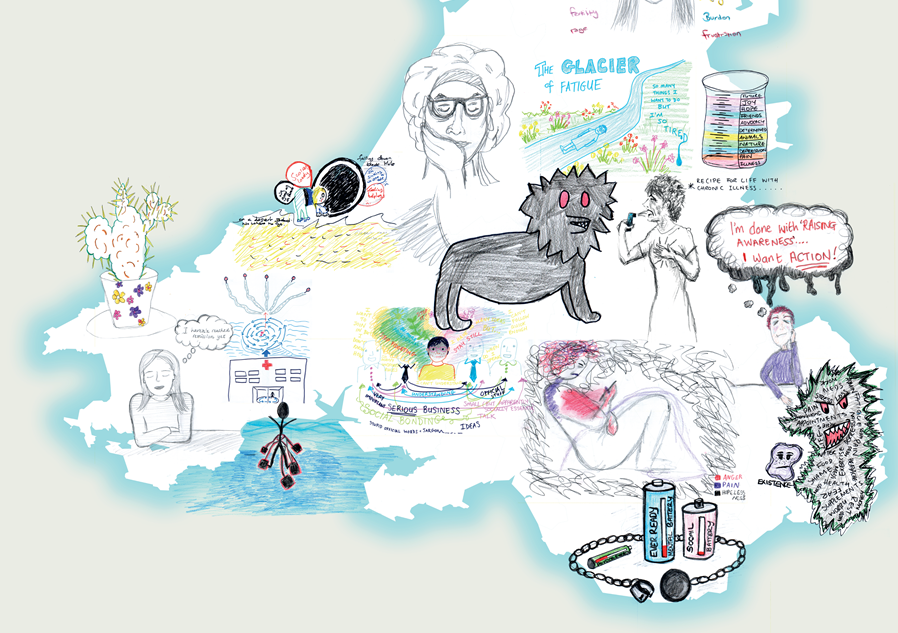
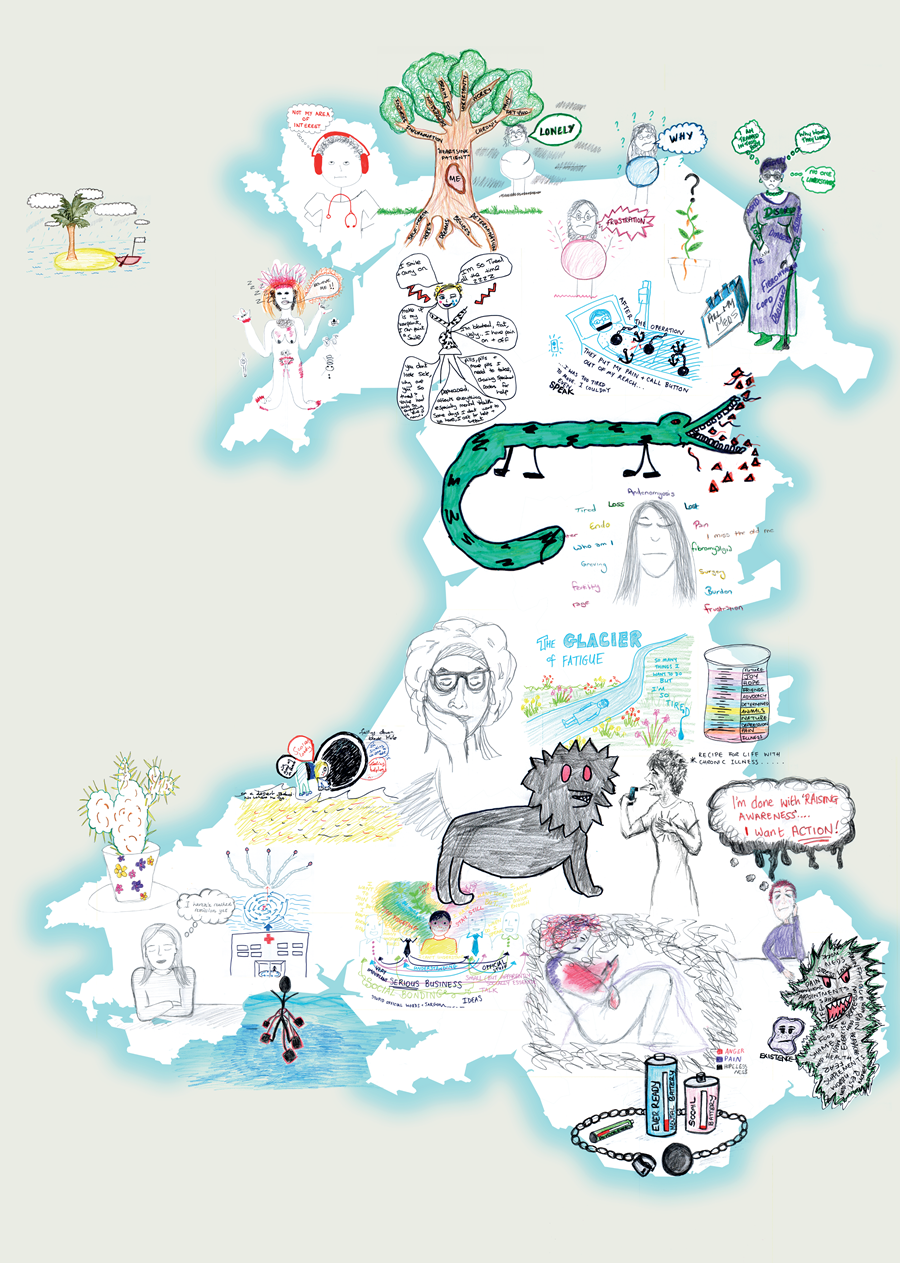
Image: Graphic created as part of the DrawingOut health project, where women illustrated their experiences of the healthcare system. Click here to view the whole image.
Find out more about the impact of Rosa’s Voices from the Frontline fund.
Hear Isabel talk about the achievements of the Fair Treatment for the Women of Wales campaign.