Surviving Economic Abuse developed a co-produced campaign with Experts by Experience. Economic Abuse has now been recognised in four government strategies.
Surviving Economic Abuse (SEA) is the only UK charity dedicated to raising awareness of economic abuse as a form of domestic abuse and to transforming responses to it. The organisation campaigns for systemic change in law, policy, and practice, and works directly with survivors to amplify their voices in policy spaces.
SEA was instrumental in securing a legal definition of economic abuse through the Domestic Abuse Act 2021 and has since focused on translating that milestone into practice, influencing policy, regulation and guidance across government, financial services, local authorities and frontline services. In 2023 to 24, SEA received £7,000 through round six of Rosa’s Voices from the Frontline fund to support a general election campaign co-produced with survivors.
SEA does not deliver frontline services. Its goal is to redesign the legal, financial and public service systems within which economic abuse happens: to close the loopholes that perpetrators exploit and, ultimately, to prevent
economic abuse.
“ If we can redesign legal, financial and public service systems so that perpetrators cannot cause this harm in the first place, we can give survivors more independence and choice and ultimately work towards preventing economic abuse for good.” — Sara D’Arcy, Head of External Affairs, SEA
Why economic abuse, and why now?
SEA’s research shows that economic abuse has affected over four million women in the UK in the last year alone. It covers any situation where a current or ex-partner controls money or economic resources: preventing someone from working, restricting access to a car or phone, controlling spending on food or clothing, taking out debt in someone else’s name, or withholding child maintenance after separation.
Economic abuse is at the heart of domestic abuse because it is what traps survivors in relationships. Without access to resources, it is almost impossible to leave. What makes it particularly devastating is that it does not require physical proximity. It often starts, continues, or escalates after separation. Many survivors end up homeless, leave stable jobs, or find themselves in debt with damaged credit scores.
Economic abuse featured in over half of the 450 domestic homicide reviews SEA has examined. It is a critical risk factor in domestic homicides and suicides. And it remains chronically under-recognised.
Having secured the legal definition, SEA identified the 2024 General Election as a critical juncture to ensure economic abuse remained on the agenda of any incoming government.
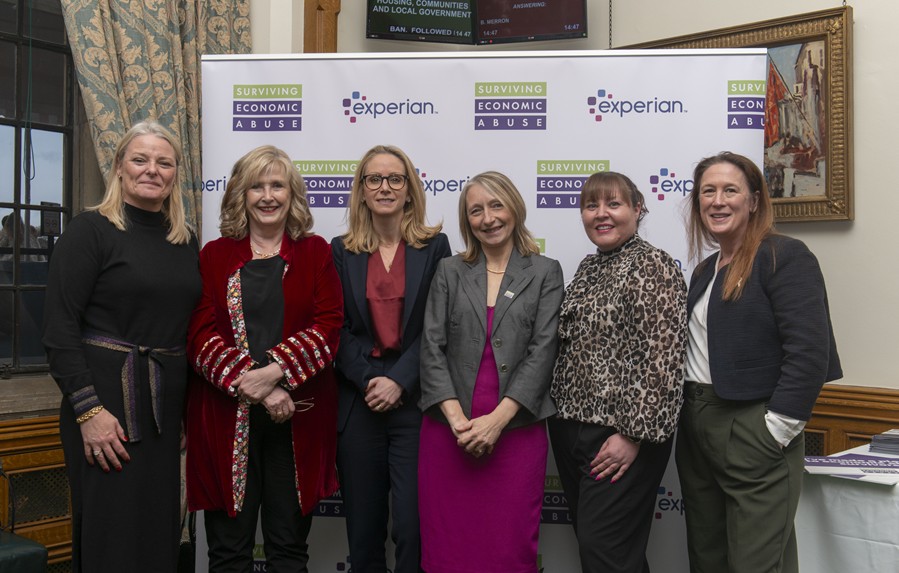
Surviving Economic Abuse (SEA) Ambassador and survivor Natalie Curtis (second from right) at a SEA parliamentary reception with Emma Wardle, Baroness Levitt, Lucy Rigby MP, SEA CEO Sam Smethers and Emily Darlington MP.
Photo credit: Zula Rabikowska
Survivors at its heart
SEA has an Experts by Experience group of over 50 survivors. Using Voices from the Frontline funding, it first surveyed the full group on their policy priorities, then formed a working group of ten members who met monthly for a year to develop a general election manifesto and co-design the campaign. It was intensive work: deep dives into specific policy areas, space for survivors to bring personal experience to bear, and sessions bridging the more technical aspects of policy development for people who had never worked in that space before.
Some of the working group members were already activists. Others had never written to a parliamentary candidate. All of them, from the feedback SEA received, found the experience a positive one.
“Because the work was so forward-facing and really focused on delivering change, they found it a positive experience even though they were focusing on a really traumatic period in their lives. They said they had learned a great deal in terms of skills, developed their confidence, and really enjoyed building relationships with other survivors in the working group.”
The campaign tools developed together included a write to-your-candidate action, briefings to help survivors engage safely with political candidates, and campaign assets designed in response to survivors’ views on how the campaign should look and feel. One of the moments SEA is most proud of was arranging a roundtable with then shadow ministers Alex Davies-Jones and Alex Norris, both now government ministers, where survivors spoke to them directly about economic abuse.
“Hearing directly from survivors really helped them understand this form of abuse in a way that policy briefings simply cannot replicate”
SEA used the co-produced manifesto as their influencing framework with the new government. Within the first six months, SEA met with six different ministers and hosted a parliamentary reception within 100 days of the new government taking office, where survivors engaged directly with ministers and over 20 MPs.
The impact has been substantial. Economic abuse is now recognised in the Government’s Violence Against Women and Girls strategy for the first time. It is also recognised in the Financial Inclusion strategy, the Homelessness strategy and the Government Debt Management strategy. Government commitments directly reflect what survivors and SEA called for in the general election manifesto. When SEA fed that back to the Experts by Experience members, it was a genuinely moving moment: they could see the things they had worked on together now reflected in Government commitments.
“ Having that freedom to campaign on these issues is incredibly generous and freeing. It enables us to drive systemic change.”
— Sara D’Arcy, Head of External Affairs, SEA
Read more about the impact of Rosa’s Voices from the Frontline fund.
Find out more about Surviving Economic Abuse on their website.
Watch Sara talk about the co-produced General Election work with Experts by Experience at Rosa’s 2024 Summer conference.
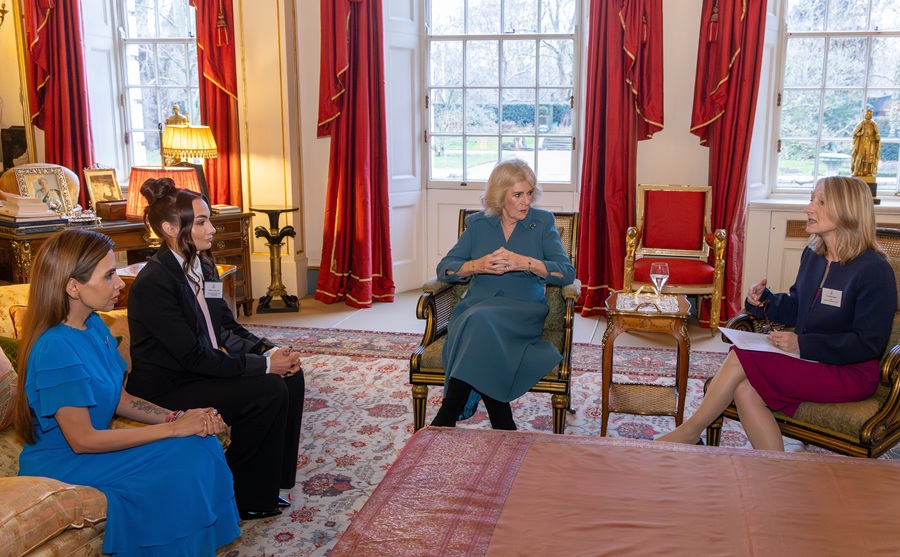
Photo at top of page: Surviving Economic Abuse Ambassadors and survivors Bijna Kotak Dasani and Rebecca
Beattie meeting Her Majesty The Queen alongside CEO Sam Smethers.
Photo credit: SEA/ Ian Jones photography